

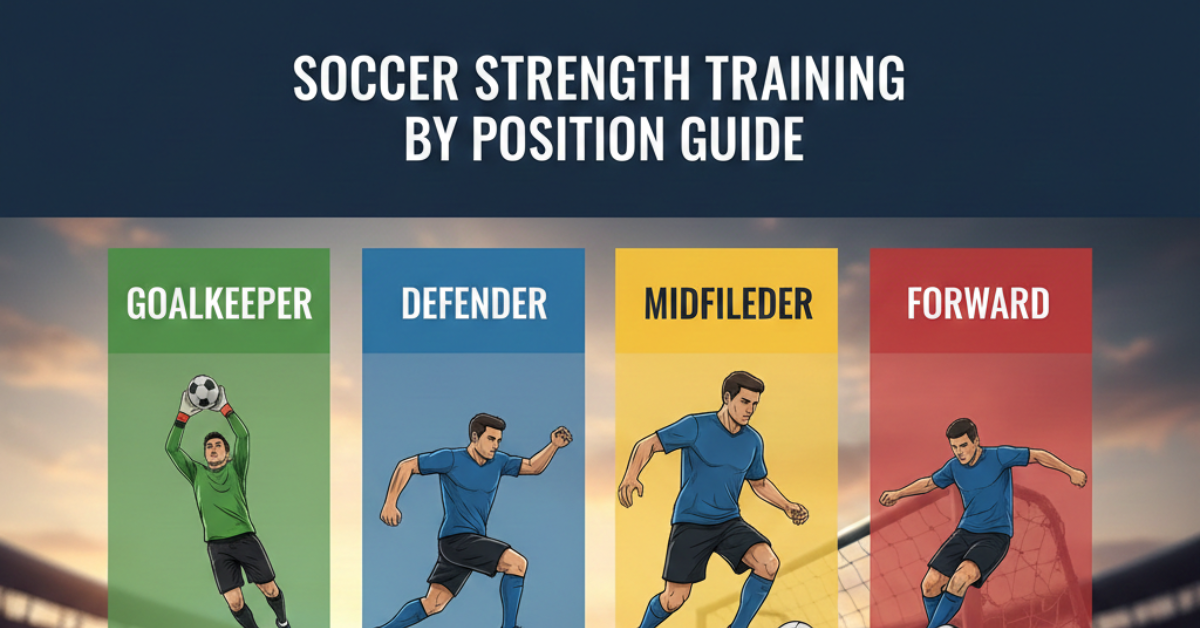
Ever notice how a center back muscles off attackers while a winger relies on blistering speed? That’s no accident. Soccer strength training isn’t one-size-fits-all—it should be tailored to your position on the field.
In modern soccer, physical performance can be the difference between winning the ball and watching the play unfold without you. This guide breaks down soccer weight training by position, showing you exactly how to structure weight training for soccer players based on specific on-field demands.
Whether you’re a goalkeeper, striker, or box-to-box midfielder, this article will help you train smarter—and stronger.
Why Position-Specific Soccer Strength Training Matters
Soccer is a dynamic, multi-directional sport. According to organizations like the FIFA and the National Strength and Conditioning Association (NSCA), players can cover 7–10 miles per match at varying intensities. That includes sprinting, jumping, tackling, decelerating, and changing direction.
But here’s the key:
-
A center back needs maximal strength and aerial dominance.
-
A winger needs acceleration and power endurance.
-
A midfielder needs repeat sprint ability.
-
A goalkeeper requires explosive strength and reaction power.
That’s why strength training for soccer players must reflect positional demands.
Soccer Strength Training by Position
Let’s break it down.
Goalkeepers: Explosive Power & Core Stability
Goalkeepers rely heavily on explosive movement—diving, jumping, and lateral pushes.
Key Physical Demands
-
Vertical jump power
-
Lateral explosiveness
-
Core stability
-
Shoulder strength
Best Strength Training for Soccer (Goalkeepers)
1. Lower-Body Power
-
Trap bar deadlifts
-
Box jumps
-
Bulgarian split squats
2. Upper-Body Strength
-
Pull-ups
-
Dumbbell bench press
-
Landmine press
3. Core & Anti-Rotation Work
-
Pallof presses
-
Dead bugs
-
Medicine ball rotational throws
Focus on explosive intent. Keep reps moderate (4–6 range) with quality rest between sets.
Defenders: Maximal Strength & Aerial Dominance
Center backs and fullbacks need strength to win duels and hold positioning.
Key Physical Demands
-
Upper-body strength in tackles
-
Lower-body power for jumping
-
Deceleration control
Soccer Weight Training for Defenders
Primary Lifts
-
Back squats or front squats
-
Romanian deadlifts
-
Bench press
Accessory Work
-
Nordic hamstring curls (injury prevention)
-
Step-ups
-
Copenhagen planks
Defenders benefit from slightly heavier loads (3–6 reps) to build foundational strength.
Midfielders: Strength Endurance & Power Repetition
Midfielders cover the most ground. They need repeat sprint ability and physical durability.
Key Physical Demands
-
High aerobic output
-
Repeated accelerations
-
Balance and coordination
Weight Training for Soccer Players (Midfield Focus)
1. Single-Leg Strength
-
Walking lunges
-
Single-leg RDLs
-
Split squats
2. Power Development
-
Kettlebell swings
-
Jump squats
3. Conditioning Circuits
-
Sled pushes
-
Battle ropes
-
Farmer’s carries
For midfielders, moderate weights with slightly higher reps (6–10 range) work well.
Forwards & Wingers: Speed & Explosive Acceleration
Strikers and wingers rely on speed, agility, and change of direction.
Key Physical Demands
-
Acceleration over 5–20 meters
-
Reactive strength
-
Quick direction changes
Strength Training for Soccer Players (Attacking Roles)
Lower-Body Explosiveness
-
Power cleans (if trained properly)
-
Box jumps
-
Hip thrusts
Sprint-Specific Strength
-
Sled pulls
-
Resisted sprints
-
Single-leg bounds
Use lighter loads moved with maximal velocity. Focus on 3–5 explosive reps per set.
Core Principles of Soccer Strength Training
Regardless of position, great strength training for soccer follows these rules:
1. Train Movements, Not Just Muscles
Soccer is multi-planar. Incorporate:
-
Rotational exercises
-
Lateral lunges
-
Anti-rotation core work
2. Emphasize Injury Prevention
Hamstring and groin injuries are common in soccer. Evidence-based exercises promoted by UEFA and sports performance programs include:
-
Nordic curls
-
Copenhagen planks
-
Eccentric hamstring work
3. Periodize Your Training
Break the year into phases:
-
Off-season: Build strength & muscle
-
Pre-season: Emphasize power and speed
-
In-season: Maintain strength with reduced volume
Sample Weekly Soccer Weight Training Split
Here’s a simple template:
2–3 Days Per Week
Day 1 – Lower Body Strength
-
Squats
-
RDLs
-
Split squats
-
Core work
Day 2 – Upper Body + Power
-
Bench press
-
Pull-ups
-
Medicine ball throws
-
Farmer’s carries
Optional Day 3 – Explosive / Speed Focus
-
Jump variations
-
Sled work
-
Sprint drills
Keep sessions under 60 minutes during the season.
Common Mistakes in Soccer Strength Training
Avoid these:
-
Bodybuilding-style isolation focus
-
Ignoring unilateral exercises
-
Lifting heavy year-round
-
Neglecting recovery
Remember: You’re training to perform on the pitch—not to win a powerlifting meet.
FAQs About Soccer Strength Training
How often should soccer players lift weights?
Most players benefit from 2–3 sessions per week. During the season, 1–2 maintenance sessions may be enough.
Does weight training make soccer players slower?
No—when programmed correctly, soccer weight training improves acceleration and power. Olympic-level sprinters lift weights for a reason.
Should youth soccer players do strength training?
Yes, under supervision. Bodyweight and light resistance training improve coordination, strength, and injury resilience.
What’s the best strength training for soccer players?
The best program depends on position, experience level, and season phase. However, compound lifts, single-leg work, and explosive training form the foundation.
Can I combine soccer practice and gym workouts?
Yes. Ideally, lift after soccer practice or on separate days. Avoid intense lower-body lifting 24 hours before matches.
Conclusion: Train for Your Position, Play at Your Best
Smart soccer strength training isn’t about lifting the heaviest weight—it’s about building position-specific power, resilience, and explosiveness.
Goalkeepers need reactive strength. Defenders need maximal force. Midfielders need endurance strength. Forwards need speed power.
When your strength training for soccer players aligns with your role on the field, performance skyrockets.