

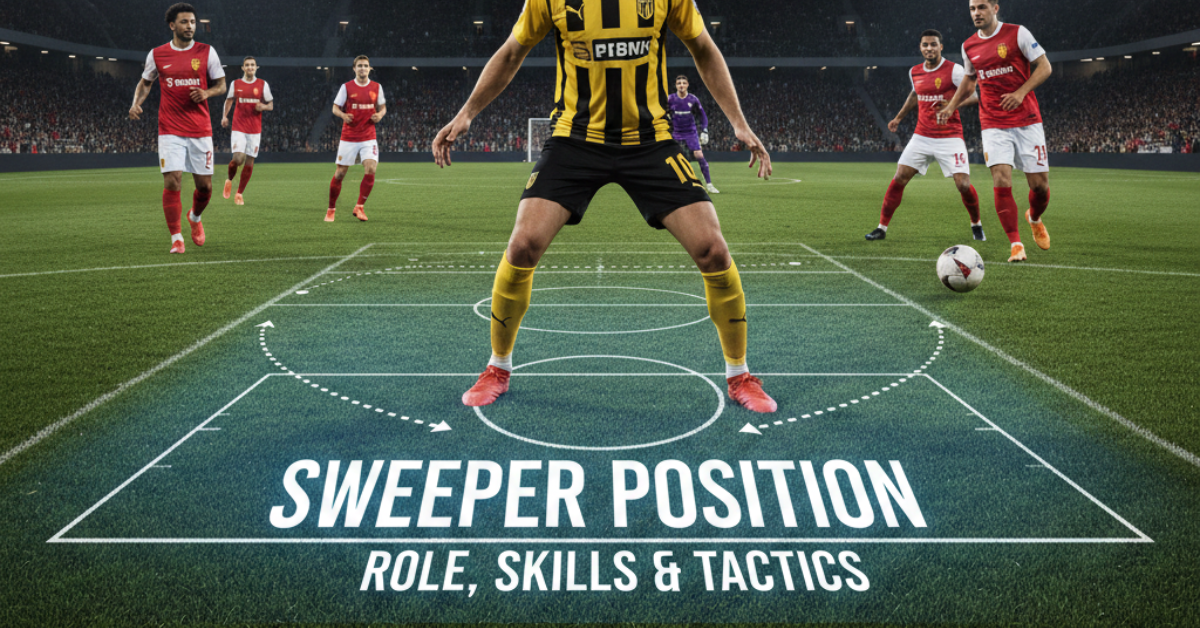
What if I told you there’s a soccer position built for players who love reading the game, making last-second tackles, and starting attacks from deep? That’s exactly what the sweeper position in soccer is all about.
While modern formations have evolved, the sweeper role remains one of the most fascinating tactical innovations in football history. In this guide, we’ll break down what a sweeper in soccer does, the skills required, its history, and whether the position still has a place in today’s game.
What Is a Sweeper in Soccer?
The sweeper soccer position, also known as the libero (Italian for “free”), is a defensive role that sits behind the line of center backs. Unlike traditional defenders, the sweeper isn’t assigned to mark a specific opponent.
Instead, the sweeper’s main job is to:
-
Provide cover for other defenders
-
Clear dangerous through balls
-
Intercept attacks before they become goal-scoring chances
-
Launch counterattacks from deep areas
Think of the sweeper as a safety net — if the defensive line gets beaten, the sweeper “cleans up” the mess.
What Does a Sweeper Do in Soccer?
If you’re wondering, what does a sweeper do in soccer on a practical level? Let’s make it simple.
A sweeper typically:
-
Reads the game better than anyone else in defense
-
Tracks attacking runs that break through the backline
-
Wins loose balls in dangerous spaces
-
Distributes the ball to start attacks
-
Organizes the defensive line
Unlike a standard center back in a flat back four, the sweeper has more freedom. That freedom requires intelligence, positioning, and composure.
The Origins of the Soccer Sweeper Position
The sweeper position became popular through the Italian tactical system known as Catenaccio. Legendary Italian coach Helenio Herrera turned it into a defensive art form during the 1960s with Inter Milan.
Later, German football refined the role with players like Franz Beckenbauer, who redefined the sweeper as both a defender and deep-lying playmaker. Beckenbauer didn’t just stop attacks — he started them.
Key Skills Needed for the Sweeper Soccer Position
Not every defender can play sweeper. This position demands a rare combination of traits.
1. Tactical Awareness
A sweeper must anticipate danger before it happens. It’s about reading the game two steps ahead.
2. Excellent Positioning
Because they play behind the defensive line, positioning is everything. One mistake and there’s no one left to cover.
3. Composure Under Pressure
Sweepers are often the last defender before the goalkeeper. Panic is not an option.
4. Ball-Playing Ability
Modern interpretations require strong passing ability. Many sweepers function like deep-lying playmakers.
5. Leadership
They organize the backline and communicate constantly. It’s a role for vocal, confident players.
Classic Sweeper vs Modern Sweeper-Keeper
The traditional sweeper position in soccer has become rare in today’s elite football. Why? Tactics evolved.
Instead of a dedicated sweeper, many teams now use:
-
Ball-playing center backs
-
High defensive lines
-
Sweeper-keepers
A sweeper-keeper is a goalkeeper who plays aggressively outside the penalty area, like Manuel Neuer. Neuer essentially modernized the sweeper concept from inside the goal.
The philosophy remains similar — cover space behind defenders — but the execution changed.
Formations That Use a Sweeper
Historically, sweepers appeared in formations such as:
-
1-3-3-3
-
1-4-3-2
-
5-3-2 (with a deeper central defender)
In these setups:
-
Two or three marking defenders press attackers
-
The sweeper floats behind them
However, in modern football, most teams prefer a flat back four or a three-center-back system without a dedicated libero.
Advantages of the Sweeper Role
Why would a coach use a sweeper?
Benefits include:
-
Extra defensive security
-
Better coverage against fast attackers
-
Stronger counterattack launches
-
More tactical flexibility
It’s particularly effective against teams that rely heavily on through balls.
Disadvantages of the Sweeper Position
Like any system, there are trade-offs.
-
Can leave midfield outnumbered
-
Risky against well-drilled pressing teams
-
Requires extremely intelligent personnel
Because modern teams press high and aggressively, the space a sweeper once controlled is often compressed.
Famous Players Who Played Sweeper
Some of football’s greatest defenders flourished in this role:
-
Franz Beckenbauer – The gold standard of the libero role
-
Franco Baresi – Defensive genius
-
Lothar Matthaus – Played sweeper later in his career
These players weren’t just defenders — they were strategists.
Is the Sweeper Position Still Used Today?
The traditional soccer sweeper position is rare in top-tier football today. However, the concept never truly disappeared.
You’ll see elements of the role in:
-
Ball-playing center backs in possession-based teams
-
Hybrid defenders in three-back systems
-
Sweeper-keepers in high lines
Football tactics evolve, but smart space coverage never goes out of style.
How to Play Sweeper in Youth or Amateur Soccer
If you’re coaching or playing at grassroots level, a sweeper can still be extremely effective.
Here’s how to implement it:
-
Choose your most tactically aware defender
-
Play them slightly deeper than the defensive line
-
Train communication drills
-
Focus on defensive shape and transitions
At youth levels, where defensive organization can be chaotic, a sweeper adds structure and security.
FAQs About the Sweeper Position in Soccer
What is a sweeper in soccer?
A sweeper is a defensive player positioned behind the main defenders, responsible for cleaning up attacks and organizing the defense.
What does a sweeper do in soccer?
They intercept passes, clear through balls, provide cover, and often initiate attacks from deep positions.
Is the sweeper position still used?
Traditional sweepers are rare in professional football today, but elements of the role exist in modern tactics, especially in sweeper-keepers.
What’s the difference between a sweeper and a center back?
A center back marks attackers directly. A sweeper plays behind center backs and covers space rather than marking a specific player.
Why is it called a libero?
“Libero” means “free” in Italian, highlighting the position’s freedom compared to other defenders.
Conclusion: The Intelligence Role of Soccer
The sweeper position in soccer may not dominate modern tactics the way it once did, but its influence is undeniable. It reshaped defensive strategy, emphasized game intelligence, and produced some of football’s greatest players.
Understanding the sweeper role gives you deeper insight into how defensive systems evolve and why tactical flexibility matters.
If you’re passionate about football tactics, consider exploring related topics like defensive formations, high defensive lines, or the role of the sweeper-keeper in modern soccer.