

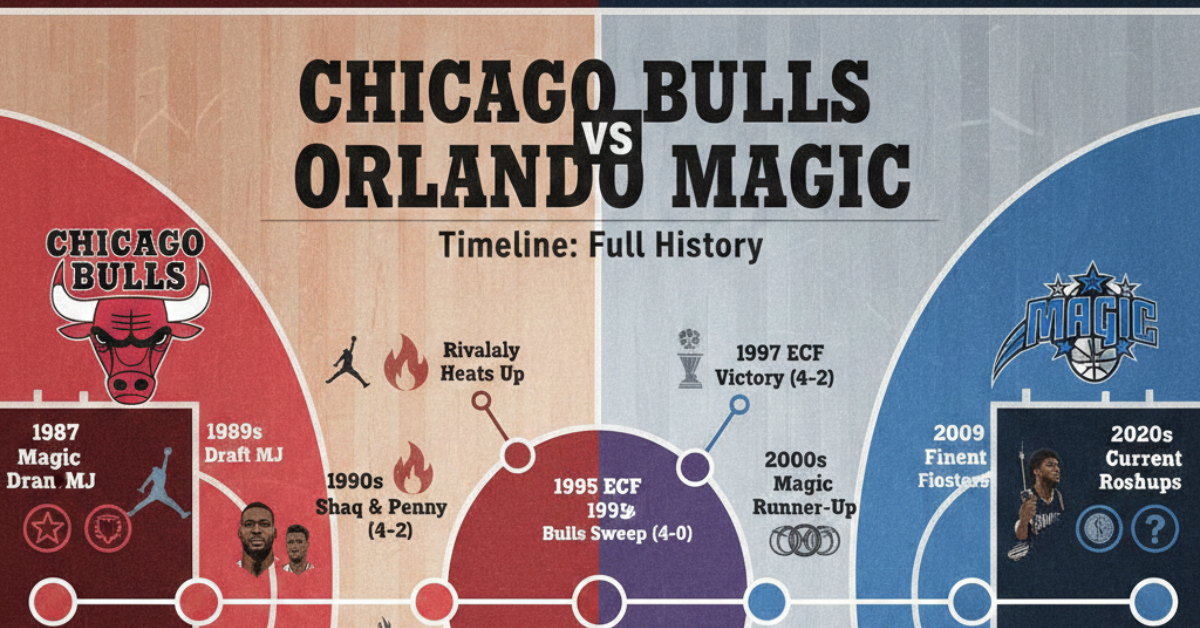
Few Eastern Conference matchups have delivered as much drama, star power, and playoff tension as the chicago bulls vs orlando magic timeline. From the dominance of the 1990s to modern-day rebuilding battles, this rivalry has quietly shaped key chapters of NBA history.
Whether you’re a longtime fan or just diving into basketball history, this guide walks you through the evolution of Bulls vs Magic — era by era, moment by moment.
The Early Years: Expansion Era Beginnings (1989–1993)
The Orlando Magic entered the NBA as an expansion franchise in 1989. Meanwhile, the Chicago Bulls were already becoming a powerhouse behind Michael Jordan.
In the early 1990s:
-
The Bulls were title contenders.
-
The Magic were developing young talent.
-
Regular season matchups were competitive but not yet heated.
At this stage of the chicago bulls vs orlando magic timeline, the rivalry lacked playoff intensity — but that was about to change.
The Shaq & Penny Era vs Jordan’s Bulls (1993–1998)
Everything shifted when Shaquille O’Neal and Anfernee Hardaway turned Orlando into a rising Eastern Conference threat.
1995 Eastern Conference Semifinals: A Defining Moment
This series remains one of the most pivotal chapters in the chicago bulls vs orlando magic timeline.
After Jordan returned from his first retirement in 1995, expectations were sky-high. But Orlando stunned Chicago:
-
Magic won the series 4–2.
-
Nick Anderson’s steal in Game 1 became iconic.
-
Orlando eliminated Chicago from the playoffs.
This moment proved:
-
The Bulls were vulnerable.
-
The Magic had arrived as legitimate contenders.
However, the following season told a different story.
1996 Eastern Conference Finals: Bulls Revenge
The 1996 season saw one of the greatest teams ever assembled. Led by Jordan, Scottie Pippen, and Dennis Rodman, Chicago dominated the league with 72 regular-season wins.
When the Bulls met Orlando in the Eastern Conference Finals:
-
Chicago swept the Magic 4–0.
-
The series wasn’t particularly close.
-
It symbolized a power shift back to Chicago.
This stretch solidified the Bulls’ dynasty and cooled Orlando’s momentum. Soon after, Shaq departed for the Los Angeles Lakers, reshaping both franchises’ futures.
Post-Dynasty Years (1999–2007)
After Jordan’s second retirement in 1998:
-
The Bulls entered a rebuild.
-
The Magic cycled through roster changes.
-
The rivalry cooled significantly.
Though regular-season matchups continued, neither team consistently contended at the same time. This phase of the chicago bulls vs orlando magic timeline lacked playoff drama but introduced new developing stars.
The Dwight Howard Era & Derrick Rose Battles (2008–2012)
The rivalry reignited during the late 2000s.
Orlando’s Rise
Led by Dwight Howard, the Magic:
-
Reached the 2009 NBA Finals.
-
Built one of the league’s most efficient inside-out offenses.
-
Became a top Eastern Conference contender.
Chicago’s New MVP
Meanwhile, the Bulls found their next superstar in Derrick Rose.
In 2011:
-
Rose won MVP.
-
Chicago secured the No. 1 seed in the East.
-
Bulls defeated Orlando in the first round of the playoffs (4–2).
This stretch added another competitive chapter to the chicago bulls vs orlando magic timeline, featuring elite defense, strong coaching, and intense matchups in the paint.
Head-to-Head Record Snapshot
Below is a summary of key playoff meetings between the franchises:
| Year | Round | Winner | Series Result | Key Players |
| 1995 | East Semifinals | Magic | 4–2 | Shaq, Penny, Jordan |
| 1996 | East Finals | Bulls | 4–0 | Jordan, Pippen |
| 2011 | 1st Round | Bulls | 4–2 | Rose, Howard |
Note: Regular season meetings span over three decades, with momentum swinging across eras.
Playing Style Evolution in the Rivalry
The chicago bulls vs orlando magic timeline also highlights how NBA basketball evolved.
1990s:
-
Mid-range offense
-
Physical defense
-
Isolation-heavy scoring
Late 2000s:
-
Stretch four lineups
-
Pick-and-roll dominance
-
Three-point shooting emphasis
Modern Era:
-
Pace-and-space offense
-
Analytics-driven rotations
-
Positionless basketball
This evolution mirrors the broader transformation of the NBA itself.
Recent Years: Youth Movement & Rebuild (2015–Present)
Both franchises entered rebuilding phases.
The Bulls built around players like:
-
Zach LaVine
-
DeMar DeRozan
The Magic invested in young talents such as:
-
Paolo Banchero
-
Franz Wagner
While the rivalry hasn’t featured recent playoff matchups, regular-season games continue to showcase emerging stars.
And with the Eastern Conference increasingly competitive, another postseason collision isn’t out of the question.
Why the Chicago Bulls vs Orlando Magic Timeline Still Matters
Even without constant playoff clashes, this rivalry is significant because:
-
It interrupted Jordan’s comeback in 1995.
-
It featured dominant centers like Shaq and Dwight Howard.
-
It bridged multiple NBA eras.
-
It showcased MVP talents across generations.
Few matchups span so many stylistic and generational shifts.
FAQs About Chicago Bulls vs Orlando Magic Timeline
Who won the 1995 Bulls vs Magic playoff series?
The Orlando Magic defeated the Chicago Bulls 4–2 in the 1995 Eastern Conference Semifinals.
Did the Bulls ever sweep the Magic?
Yes. Chicago swept Orlando 4–0 in the 1996 Eastern Conference Finals.
How many times have they met in the playoffs?
They have met three times in the NBA playoffs (1995, 1996, and 2011).
Who are the most notable players in this rivalry?
Key players include Michael Jordan, Shaquille O’Neal, Scottie Pippen, Derrick Rose, Dwight Howard, and newer stars like Paolo Banchero.
Is the rivalry active today?
While not considered a heated rivalry today, regular-season matchups still feature promising young talent and competitive games.
Conclusion: A Rivalry That Spans Generations
The chicago bulls vs orlando magic timeline isn’t just a series of games — it’s a reflection of NBA evolution itself. From Jordan vs Shaq to Rose vs Howard to today’s rising stars, the rivalry showcases three decades of basketball transformation.
This matchup offers a fascinating lens into shifting dynasties, superstar battles, and the ever-changing Eastern Conference landscape.