

If you’ve ever glanced at baseball stats and wondered, you’re not alone. OPS is one of those numbers that pops up everywhere, from TV broadcasts to fantasy baseball rankings, yet it often isn’t clearly explained.
In simple terms, OPS is a powerful stat that helps measure a player’s overall offensive value. In this guide, we’ll break down what OPS stands for in baseball stats, how it’s calculated, why it matters, and how to actually use it to understand player performance—without drowning in math.
What Does OPS Stand for in Baseball Statistics?
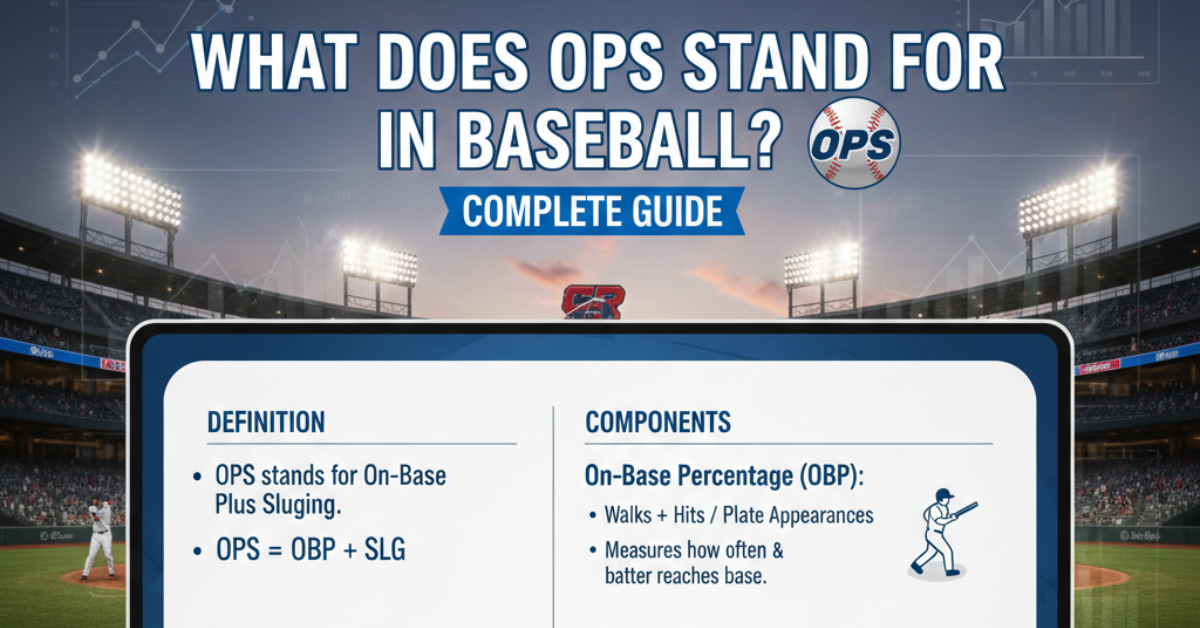
OPS stands for On-base Plus Slugging.
It combines two core offensive metrics:
- On-Base Percentage (OBP) – How often a player reaches base
- Slugging Percentage (SLG) – How much power a player hits with
The formula is straightforward:
OPS = OBP + SLG
That’s it. No hidden math, no complicated weighting—just one stat that blends patience and power into a single number.
Why OPS Matters in Baseball Terminology
In baseball terminology, OPS is valued because it answers a simple but important question:
How good is this player offensively, overall?
Traditional stats like batting average only tell part of the story. OPS goes further by capturing:
- A player’s ability to get on base
- A player’s ability to hit for extra bases
- Overall run-producing potential
That’s why OPS has become a favorite among scouts, analysts, and front offices alike.
Breaking Down OPS: OBP vs. SLG
On-Base Percentage (OBP)
OBP measures how often a player avoids making an out. It includes:
- Hits
- Walks
- Hit-by-pitches
This rewards plate discipline—not just contact.
Slugging Percentage (SLG)
SLG focuses on power by weighting hits:
- Singles = 1 base
- Doubles = 2 bases
- Triples = 3 bases
- Home runs = 4 bases
A slugger with fewer hits but more power can still have a strong SLG.
OPS brings both of these together, giving a fuller picture of offensive value.
What Is a Good OPS in Baseball?
OPS numbers can be confusing without context, so here’s a quick breakdown:
- .900 and above – Elite hitter
- .800 to .899 – Very good
- .700 to .799 – League average
- Below .700 – Below average
Keep in mind: league averages change slightly from season to season, especially across different eras of baseball.
How OPS Is Used in Modern Baseball Stats
OPS isn’t just for fans—it’s used everywhere in modern baseball:
- Player evaluations
- Contract negotiations
- MVP debates
- Fantasy baseball rankings
Because it’s easy to read and fairly reliable, OPS often serves as a quick snapshot of offensive performance.
That said, advanced metrics like OPS+, wOBA, and WAR build on OPS by adjusting for ballparks and league conditions.
Limitations of OPS You Should Know
While useful, OPS isn’t perfect.
Some limitations include:
- OBP and SLG are weighted equally (which may not reflect real run value)
- It ignores base running and situational hitting
- It doesn’t account for park effects unless adjusted (OPS+ does)
Still, for a single, easy-to-understand stat, OPS delivers a lot of value.
| Stat | What It Measures |
| Batting Average | Hits per at-bat |
| OBP | Reaching base |
| SLG | Power hitting |
| OPS | Overall offense |
| OPS+ | OPS adjusted for era and park |
OPS vs Other Baseball Statistics
OPS hits the sweet spot between simplicity and insight.
FAQs: What Does OPS Stand for in Baseball?
What does OPS stand for in baseball stats?
OPS stands for On-base Plus Slugging, combining OBP and SLG to measure offensive performance.
What does OPS stand for in baseball statistics used by MLB?
MLB uses OPS as a standard offensive metric, often alongside OPS+ for adjusted comparisons.
Is OPS a good stat for comparing players?
Yes, especially for hitters. It’s not perfect, but it’s very effective for quick comparisons.
What is a bad OPS in baseball?
Generally, an OPS below .700 is considered below league average.
Why do analysts prefer OPS over batting average?
Because OPS captures both patience and power, giving a more complete picture of offense.
Conclusion: Why OPS Is Worth Understanding
So, what does OPS stand for in baseball? At its core, it’s one of the clearest ways to understand how productive a hitter really is. By blending on-base ability with power, OPS delivers a more honest snapshot of offensive value than traditional stats alone. If you’re looking to dig deeper, consider exploring related metrics like OPS+, WAR, or wOBA—or try comparing OPS across different seasons to see how the game has evolved.