

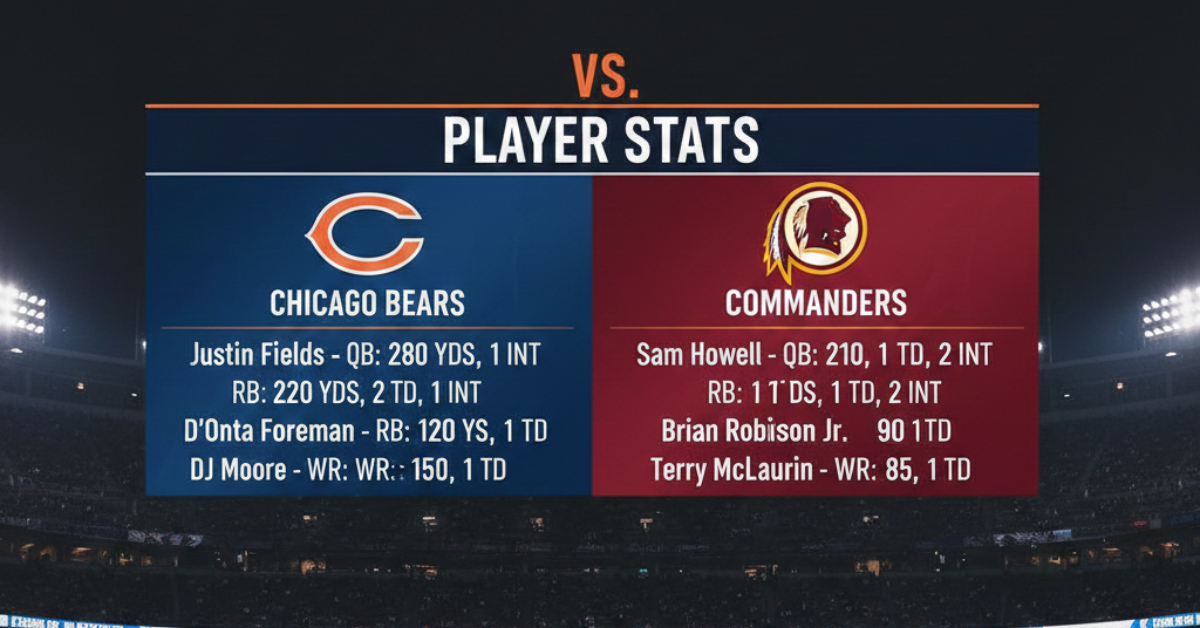
When the Chicago Bears vs Washington Commanders match player stats hit the box score, fans quickly realized this wasn’t just another regular-season game — it was a statement performance. Big plays, quarterback duels, defensive stands, and surprising stat lines made this matchup one worth dissecting.
In this article, we’ll break down the full player stats, highlight top performers, analyze game-changing moments, and explain what it all means moving forward.
Game Overview: Bears vs Commanders Recap
The matchup between the Chicago Bears and the Washington Commanders delivered offensive firepower and defensive adjustments that shifted momentum throughout the contest.
Both teams entered the game looking to establish rhythm on offense and consistency on defense. The statistical battle ultimately revealed:
-
Quarterback efficiency differences
-
Third-down conversion impact
-
Turnover margins
-
Explosive play production
Let’s dive straight into the numbers.
Quarterback Comparison and Passing Stats
Quarterback play often defines these matchups — and this game was no different.
Passing Statistics Table
| Player | Team | Comp/Att | Yards | TD | INT | QB Rating |
| Justin Fields | Bears | 15/29 | 282 | 4 | 0 | 125.3 |
| Sam Howell | Commanders | 37/51 | 388 | 2 | 1 | 97.9 |
Analysis
Justin Fields delivered one of his most efficient performances of the season. His 4 touchdowns showcased improved decision-making and deep-ball accuracy.
On the other side, Sam Howell threw for more yards but needed significantly more attempts. While 388 passing yards looks impressive, the interception proved costly during a pivotal drive.
Key Takeaways:
-
Fields was more explosive per throw.
-
Howell relied on volume passing.
-
Red-zone efficiency favored Chicago.
Rushing Leaders and Ground Game Stats
While passing grabbed headlines, the run game told its own story.
Top Rushers
| Player | Team | Carries | Yards | Avg | TD |
| Khalil Herbert | Bears | 10 | 76 | 7.6 | 0 |
| Brian Robinson Jr. | Commanders | 10 | 31 | 3.1 | 0 |
What Stood Out
-
Chicago averaged over 7 yards per carry with Herbert.
-
Washington struggled to establish run consistency.
-
Bears controlled tempo with balanced play-calling.
The rushing efficiency gave Fields more play-action opportunities, directly impacting passing success.
Receiving Breakdown and Target Leaders
Receiver production often defines explosive games, and this contest featured multiple standout performances.
Top Receiving Stats
| Player | Team | Receptions | Yards | TD |
| DJ Moore | Bears | 8 | 230 | 3 |
| Terry McLaurin | Commanders | 6 | 104 | 0 |
| Curtis Samuel | Commanders | 5 | 73 | 1 |
Spotlight Performance
DJ Moore had a career night. With 230 yards and 3 touchdowns, he consistently beat coverage and turned short routes into explosive gains.
Meanwhile, Terry McLaurin surpassed 100 yards, but Washington struggled to convert his production into scoring drives.
Defensive Impact Players
Defense often decides close NFL games, and several players stepped up.
Chicago Defensive Highlights:
-
5 total sacks
-
1 forced turnover
-
3 red-zone stops
Washington Defensive Stats:
-
2 sacks
-
4 tackles for loss
-
Multiple pressures but inconsistent containment
-
Chicago’s ability to create pressure disrupted timing and limited deep-shot opportunities late in the game.
Key Game-Changing Moments
Here are the three plays that shifted momentum:
-
Moore’s 56-yard touchdown reception in the second quarter
-
Howell’s fourth-quarter interception
-
Chicago’s fourth-down defensive stand
These moments directly impacted scoring swing and field position control.
Team Comparison Stats
| Category | Bears | Commanders |
| Total Yards | 451 | 388 |
| Passing Yards | 282 | 388 |
| Rushing Yards | 169 | 70 |
| Turnovers | 0 | 1 |
| Third Down % | 45% | 38% |
What the Numbers Reveal
-
Chicago was more balanced offensively.
-
Washington relied heavily on passing volume.
-
Turnover margin proved decisive.
Advanced Stats and Efficiency Metrics
If we go deeper into analytics:
-
Yards per play: Bears dominated.
-
Explosive plays (20+ yards): Chicago led significantly.
-
Red-zone efficiency: Bears capitalized; Commanders stalled.
Modern NFL success often comes down to efficiency, not just yardage totals — and the Bears won that battle.
What This Means Going Forward
For Chicago:
-
Offensive identity is emerging.
-
Connection between Fields and Moore is dangerous.
-
Defensive pass rush improving at the right time.
For Washington:
-
Offensive line protection remains a concern.
-
Passing game strong but too one-dimensional.
-
Defensive adjustments needed in secondary coverage.
FAQs: Chicago Bears vs Washington Commanders Match Player Stats
1. Who had the most passing yards in the game?
Sam Howell led with 388 passing yards.
2. Who was the top performer overall?
DJ Moore had the most impactful performance with 230 receiving yards and three touchdowns.
3. Which team won the turnover battle?
The Bears finished with zero turnovers compared to Washington’s one interception.
4. How did Justin Fields perform?
Fields threw four touchdowns with no interceptions and posted a strong QB rating of 125.3.
5. What was the biggest statistical difference?
Rushing efficiency and explosive plays heavily favored Chicago.
Final Thoughts
The Chicago Bears vs Washington Commanders match player stats tell a deeper story than the scoreboard alone. Chicago’s balanced attack, explosive receiving, and defensive pressure proved more efficient than Washington’s high-volume passing strategy.