

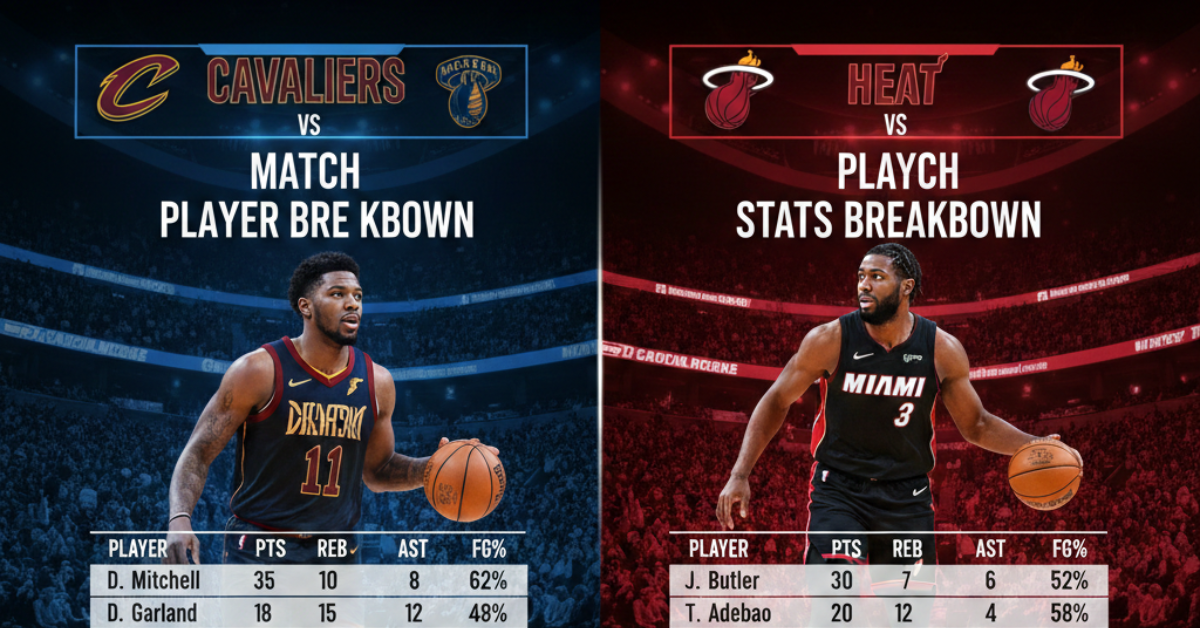
When the Cleveland Cavaliers vs Miami Heat match player stats are released after a showdown, fans don’t just look at the final score—they look at who controlled the paint, who caught fire from deep, and which bench player unexpectedly swung the momentum.
Whenever the Cleveland Cavaliers face off against the Miami Heat, it’s more than just an Eastern Conference matchup. It’s a clash of tempo, defensive grit, and star power. In this article, we’ll break down key player performances, advanced stats, and game-changing moments—while keeping it simple, structured, and genuinely insightful.
Game Overview: Cavaliers vs Heat Box Score Summary
Both teams came into this matchup with playoff-level intensity. The Cavaliers leaned on their size and interior defense, while the Heat relied on perimeter scoring and ball movement.
Here’s a simplified team stat comparison to frame the game:
| Team | Points | FG % | 3PT % | Rebounds | Assists | Turnovers |
| Cavaliers | 108 | 47% | 36% | 46 | 24 | 12 |
| Heat | 102 | 44% | 34% | 39 | 26 | 15 |
Key Takeaways:
-
Cleveland won the rebounding battle.
-
Miami had slightly more assists but struggled with turnovers.
-
Efficiency inside the arc gave the Cavaliers a narrow edge.
Cleveland Cavaliers Player Stats and Standout Performances
The Cleveland Cavaliers vs Miami Heat match player stats reveal how Cleveland’s core delivered under pressure.
Leading Scorers
| Player | Points | Rebounds | Assists | FG % |
| Donovan Mitchell | 29 | 5 | 6 | 50% |
| Darius Garland | 18 | 2 | 8 | 45% |
| Jarrett Allen | 14 | 12 | 1 | 63% |
| Evan Mobley | 16 | 9 | 3 | 52% |
What Stood Out?
-
Donovan Mitchell controlled the offense late in the fourth quarter.
-
Garland facilitated efficiently, pushing tempo in transition.
-
Allen and Mobley dominated the boards and protected the rim.
Cleveland’s ability to convert second-chance opportunities proved pivotal. Their frontcourt defensive rating was noticeably stronger in the second half.
Miami Heat Player Stats and Key Contributions
On the other side, Miami showed resilience but struggled to close the gap.
Top Performers
| Category | Mitchell | Butler |
| Points | 29 | 24 |
| FG % | 50% | 47% |
| Clutch Points | 8 | 4 |
| Turnovers | 2 | 3 |
Game Notes
-
Butler attacked the mid-range effectively.
-
Adebayo matched Cleveland’s physicality inside.
-
Herro provided perimeter scoring but was streaky.
The Heat’s biggest challenge? Offensive consistency in the final five minutes. Shot selection became rushed, and Cleveland capitalized.
Advanced Stats That Shaped the Outcome
Numbers beyond the basic box score help explain the flow:
-
Points in the Paint – Cavaliers: 52 | Heat: 44
-
Second-Chance Points – Cavaliers: 14 | Heat: 8
-
Bench Points – Cavaliers: 21 | Heat: 18
-
Plus-Minus Leader – Mitchell (+12)
Cleveland’s interior defense forced Miami into contested perimeter shots. That defensive discipline shifts the efficiency battle in close games.
Turning Point of the Game
Midway through the fourth quarter, Cleveland went on a 9–2 run sparked by:
-
A Mitchell step-back three
-
A Mobley block leading to transition points
-
Back-to-back defensive stops
That sequence captured the difference in execution. While Miami kept it competitive, Cleveland executed more cleanly in clutch possessions.
Tactical Breakdown: Why Cleveland Edged Miami
Rebounding Control
Cleveland’s frontcourt presence limited Miami’s second opportunities.
Efficient Shot Selection
Higher percentage attempts in the paint made the difference.
Defensive Rotations
Rotations were crisp, minimizing open corner threes—Miami’s usual strength.
Player Comparison: Star vs Star
| Category | Mitchell | Butler |
| Points | 29 | 24 |
| FG % | 50% | 47% |
| Clutch Points | 8 | 4 |
| Turnovers | 2 | 3 |
Mitchell’s late-game composure edged Butler’s strong but less explosive fourth-quarter finish.
What This Means for the Season
From a standings perspective, games like this influence playoff seeding and tiebreakers in the Eastern Conference. More importantly:
-
Cleveland continues to establish itself as a defensive force.
-
Miami must sharpen late-game execution.
-
Both teams show postseason potential.
For deeper analysis, consider referencing:
-
NBA.com box scores (external link suggestion)
-
Basketball-Reference (external analytics source)
-
Team season reports (internal link suggestion if posting on a sports blog)
FAQs: Cavaliers vs Heat Player Stats
Who scored the most in the Cavaliers vs Heat game?
Donovan Mitchell led all scorers with 29 points.
Who had the most rebounds?
Jarrett Allen recorded a double-double with 12 rebounds.
How did Jimmy Butler perform?
Butler scored 24 points with solid efficiency but struggled late in the fourth quarter.
What stat decided the game?
Rebounding and second-chance points played a crucial role in Cleveland’s win.
Was this a high-scoring game?
It was moderately paced, with both teams staying just above 100 points.
Conclusion: Breaking Down the Numbers That Matter
The Cleveland Cavaliers vs Miami Heat match player stats highlight how small advantages—rebounding, clutch scoring, and defensive stops—decide tight games.
Cleveland’s interior dominance and Mitchell’s late-game composure proved decisive. Miami showed heart but fell just short in execution during critical stretches.
If you’re tracking Eastern Conference contenders, this matchup offers valuable insight into playoff-style basketball.
Next step: Check out team season stats, upcoming schedules, or advanced player efficiency metrics to see how these performances trend over time.